llm-news
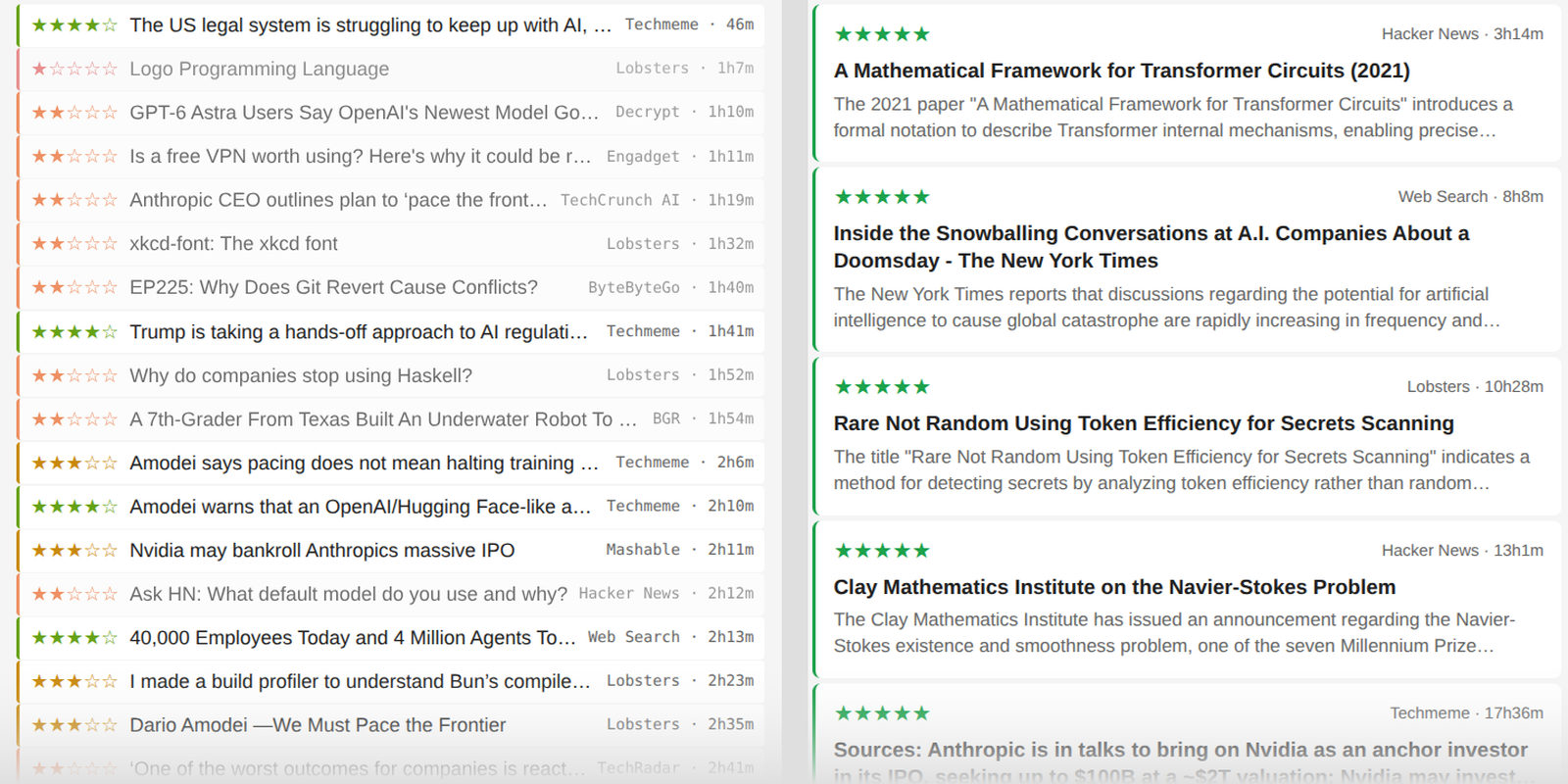
LiveA live tech news feed, curated and ranked by AI.
Aggregates and ranks tech and AI news from 70+ sources, refreshed hourly. Articles are summarized and rated for relevance; thematic clusters surface evolving stories.
LLM Works
LLM Works builds AI agents on its own open-source substrate, and turns the newest research into production-grade systems that power existing pipelines or create new ones from scratch.
New agent methods appear every month, but very few reach real-world production. We distill the best of them into our platform, hardened and ready to deploy in your pipeline, with you.
Built on the open source substrate. What we deploy stays yours.
Multi-layer library stack covering all aspects of semi-autonomous agents implementation: typed contracts around the model, verification loops, tracing, memory and learning.
Reasoning stays in the model. Guarantees live outside it.
Highly refined & purpose-built loops.
Our production agents are custom-built and optimized to solve a specific problem. We deploy state-of-the-art loop techniques and combine them with suitable existing methods from science and technology, such as k-means clustering and knowledge graphs.
A live tech news feed, curated and ranked by AI.
Aggregates and ranks tech and AI news from 70+ sources, refreshed hourly. Articles are summarized and rated for relevance; thematic clusters surface evolving stories.


Deep research powered by AI.
Decision-grade research output: calibrated verdicts through self-refining loops, with a plan-as-protagonist architecture that surfaces what was checked, what changed the verdict, and what's still open.
An open-source substrate for the engineering layer around production LLM agents
Every agent runs on a modular architecture enabling a clean on-LLM / off-LLM boundary.
The engineering layer around the model turns model calls into production agents. The platform builds it once, so every agent inherits the capabilities.
Platforms that ship as one blob are hard to compose, extend, or swap parts of. Adoption is all-or-nothing and hard to walk back.
Without higher-level abstractions, business logic becomes complex. Every model call turns into request formatting, response parsing, and retry handling.
Every dependency, upgrade, and breaking change costs engineering hours. The maintenance bill grows with the codebase.
AI is going through an engineering shift seen in several industries before